0
  • DE
  • EN
  • FR
  • International Database and Gallery of Structures

Advertisement

General Information

Other name(s): Manchester Metrolink Finback Bridge
Completion: 2006
Status: in use

Project Type

Location

Location: , , , ,
Part of:
Coordinates: 53° 30' 7" N    2° 11' 45" W
Show coordinates on a map

Technical Information

Dimensions

width 10.25 m
total length 131.8 m
span lengths 87.9 m - 43.9 m
clearance 4.80 m
number of spans 2
number of tracks 2
track gauge 1 435 mm
abutments number 2
deck deck slab thickness 0.25 - 0.60 m
girder depth 4.5 - 7.0 m
girder width 2.5 m
piles diameter 1.050 m

Design Loads

design code(s) BS 5400 Part 2

Materials

deck prestressed concrete
piers reinforced concrete
abutments reinforced concrete

Notes

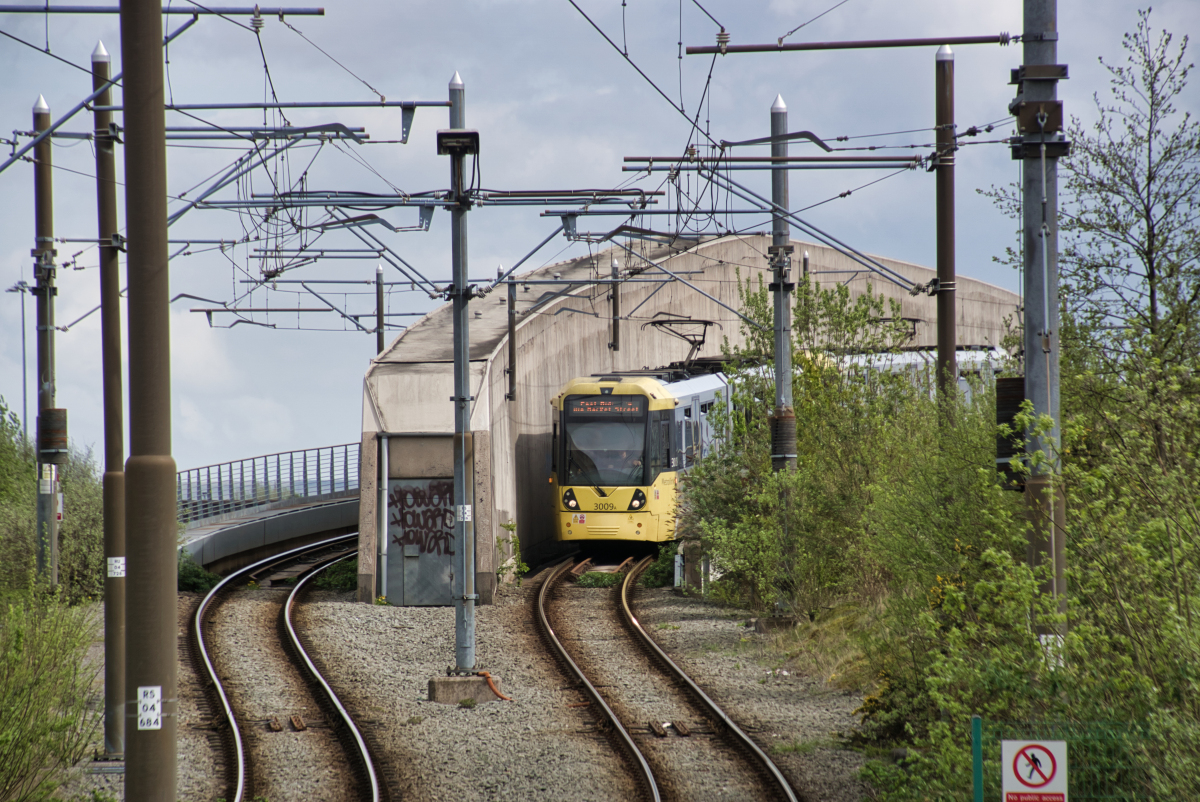
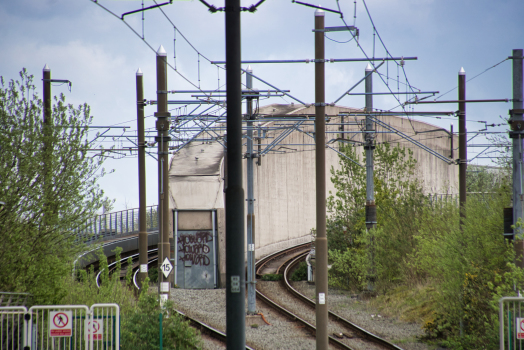
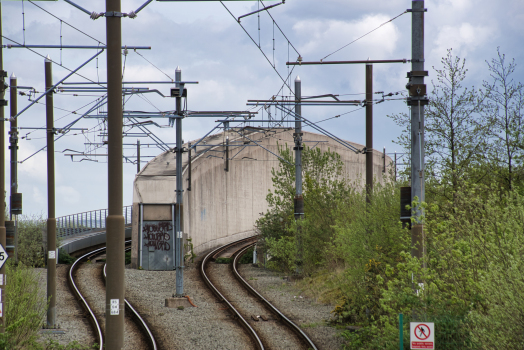
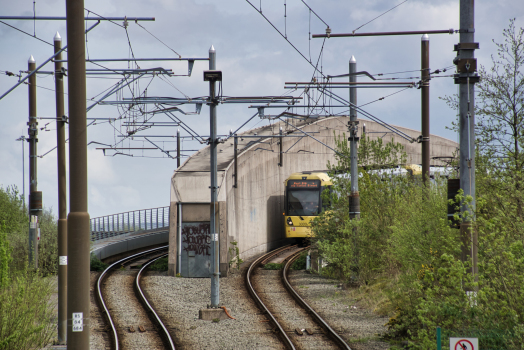
The Metrolink Finback Bridge in Manchester was designed to carry the tram lines of the proposed Metrolink Phase 3 tram system over the active Manchester to Leeds Trans-Pennine railway. The project required innovative thinking due to the complexity of site constraints, safety considerations, and the need to avoid disruption to the busy operational railway. Instead of tunneling beneath the railway, a post-tensioned concrete finback bridge was chosen, offering a robust and efficient solution.

The site’s location in the Moston area of northeast Manchester meant that the tram route had to cross four active rail tracks. The previous heavy rail configuration involved level points, but for the new tram line, a grade-separated solution was required to meet modern safety standards. A key factor in design selection was minimizing interference with railway operations and limiting the extent of alterations needed to existing structures, particularly the nearby Thorp Road Bridge.

Ground conditions posed another challenge. The construction site comprised 1.5 meters of made ground resting on layers of ballast, gravel, cobbles, and firm glacial till, which extended approximately 33 meters below the surface. The bridge’s design accounted for these geotechnical conditions to ensure stability and long-term structural integrity.

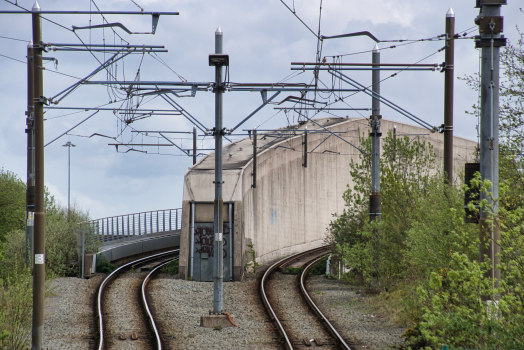
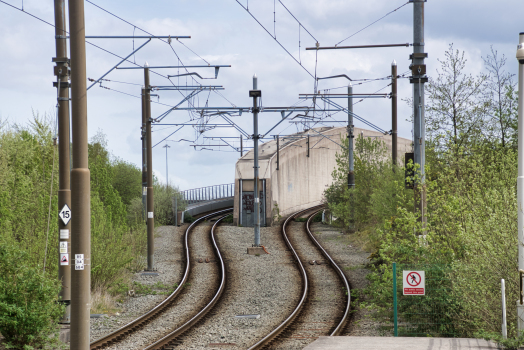
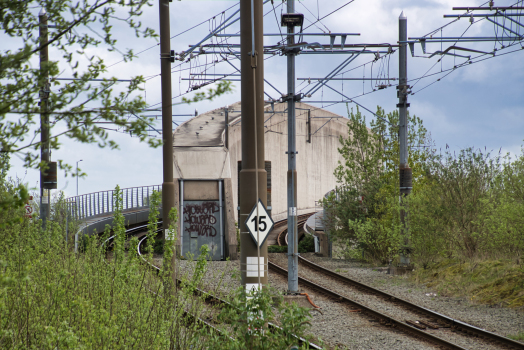
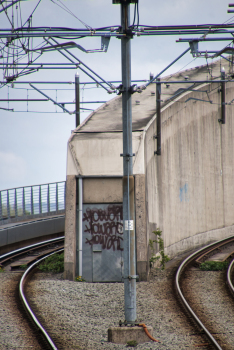
The final bridge design featured a 131.8-meter-long, two-span post-tensioned concrete box-girder structure with a distinctive finback form. Its main span measured 87.9 meters, with a back span of 43.9 meters. The bridge's fin varied in height, rising from 4.5 meters at the abutments to 7.0 meters at the central support, while the bottom flange extended outwards as cantilevers to support the tram tracks.

An innovative aspect of the construction was the method used to install the bridge. The bridge was initially built alongside the railway, in a position parallel to the tracks and beyond the railway clearance lines. Upon completion, the entire 6,250-tonne structure was rotated by 21 degrees into its final alignment during a carefully planned weekend possession of the railway.

The substructure design included foundations made of large-diameter reinforced concrete piles. The central support rested on 28 piles, arranged asymmetrically to match the load distribution. At the east abutment, 10 piles provided support, while the west abutment included a pad foundation with post-tensioning tendons to counter uplift forces from the short back span.

The bridge superstructure was meticulously engineered. Its box-girder design allowed it to handle torsional forces generated by the S-shaped curve of the tram alignment. Internal diaphragms helped control distortion, and external post-tensioned tendons provided additional strength. The design incorporated advanced considerations for temperature variation and time-dependent material behaviors such as creep and shrinkage.

Post-tensioning systems played a crucial role in the bridge’s structural performance. External tendons were protected in greased and sheathed strands within HDPE ducts, while internal tendons in the slab used grouted bare strands in corrugated ducts. Stressing procedures were customized to the site constraints, with jacking performed primarily from one end.

The final rotation of the bridge into position required complex temporary works, including a steel fabrication nosepiece at the east end, sliding tracks with PTFE surfaces, and precise jacking systems. The geometry and loading conditions were continually analyzed during construction to ensure safety and structural integrity, with adjustments made in real-time as necessary.

In conclusion, the Metrolink Finback Bridge is a remarkable example of engineering ingenuity. It demonstrates how advanced design, construction planning, and innovative techniques can solve complex challenges. The successful rotation and installation of the bridge with minimal railway disruption highlight the effectiveness of collaborative engineering solutions tailored to demanding environments.

Relevant Web Sites

There currently are no relevant websites listed.

Relevant Publications

  • About this
    data sheet
  • Structure-ID
    20014749
  • Published on:
    13/12/2004
  • Last updated on:
    17/04/2024
Structurae cooperates with

International Association for Bridge and Structural Engineering (IABSE)
e-mosty Magazine
e-BrIM Magazine