0
  • DE
  • EN
  • FR
  • International Database and Gallery of Structures

Advertisement

General Information

Completion: 1939
Status: out of service

Project Type

Structure: Steel truss tower (free standing)
Function / usage: original use: Drop tower
Material: Steel tower or mast

Awards and Distinctions

Location

Location: , , ,
Coordinates: 40° 34' 22.80" N    73° 59' 3.84" W
Show coordinates on a map

Technical Information

Dimensions

height 80 m

Materials

truss steel

Chronology

1939

The tower is built for the 1939 New York World's Fair in Flushing Meadows Park, Queens.

1941

The tower is moved to its current site, as part of the Steeplechase Park amusement park.

Excerpt from Wikipedia

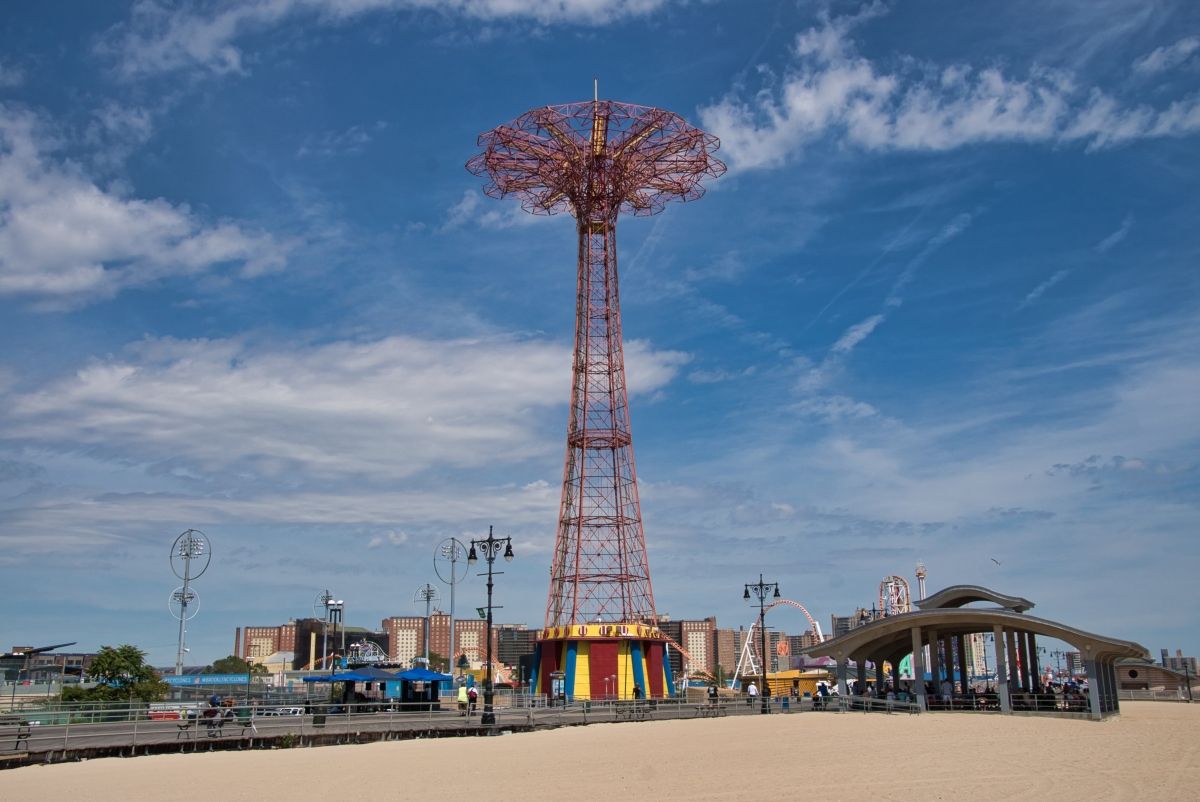
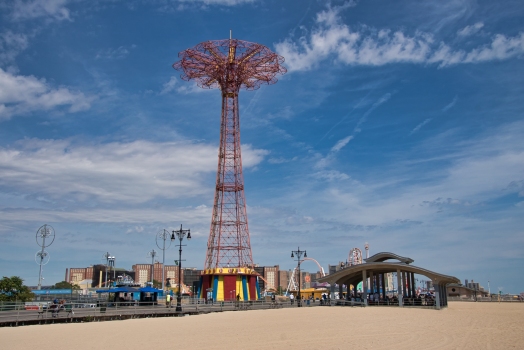
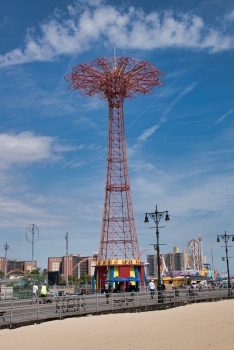
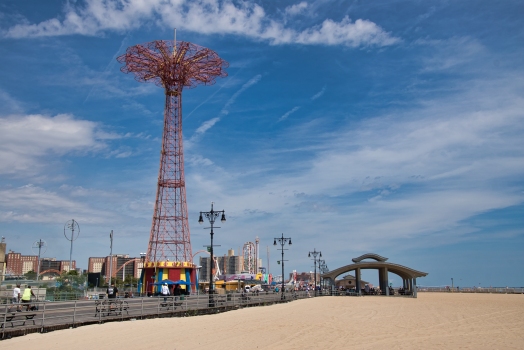
The Parachute Jump is a defunct amusement ride on the Riegelmann Boardwalk near West 18th Street in Coney Island, Brooklyn, New York City. Its open-frame steel structure measures 250 feet (76 m) tall and weighs 170 tons (150 tonnes).

The ride consisted of twelve cantilevered steel arms radiating from the top of the tower, each of which supported a parachute attached to a lift rope and a set of surrounding guide cables. Riders were belted into a two-person canvas seat and dropped from the top, though the parachute and shock absorbers at the bottom slowed their descent. It was expensive to operate, as each parachute required three cable operators.

The ride was originally built for the 1939 New York World's Fair in Flushing Meadows–Corona Park, Queens. Following the conclusion of the fair, the Parachute Jump was moved to its current site, then part of the Steeplechase Park amusement park, in 1941. The ride ceased operations in the 1960s when the park shut down. Despite subsequent efforts to either demolish the Parachute Jump or restore it to operating condition, disputes over its use caused the Parachute Jump to remain unused through the 1980s. Since the 1990s, the Parachute Jump has been renovated several times, both for stability and aesthetic reasons. The frame was outfitted with a lighting system after the ride's closure.

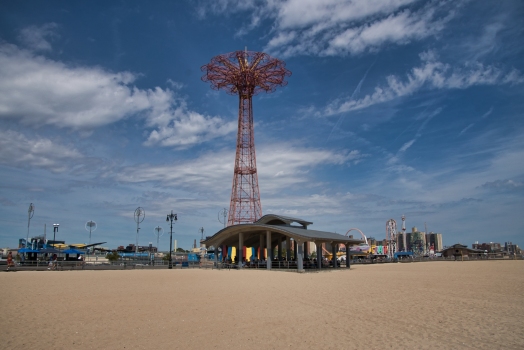
Today, the Parachute Jump is the only extant portion of Steeplechase Park. It is protected as both a New York City designated landmark and a National Register of Historic Places listing.

Description

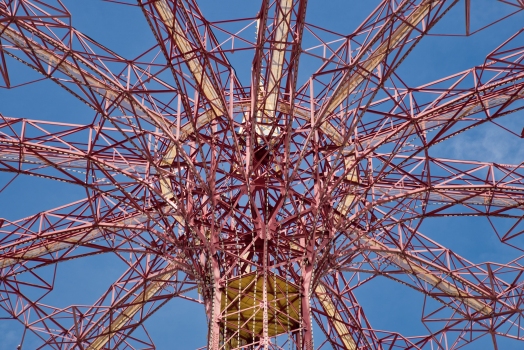
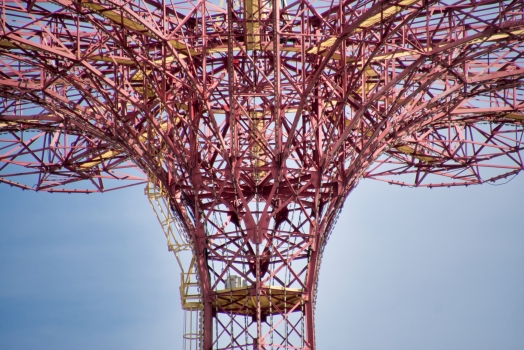
The Parachute Jump contains a hexagonal base, upon which is located a "space-frame"-style steel structure with six sides. The legs are grounded on concrete foundations, each of which contain twelve timber piles. Each of the "legs" in the structure is a 12-inch-wide (30 cm) flange column, braced by horizontal ribs at 7-foot (2.1 m) intervals and by diagonal ribs that run between the horizontal beams. The diagonal and horizontal ribs intersect at gusset plates riveted to the column webs, and there are splices along the legs at 30-foot (9.1 m) intervals. A ladder was located on the north side of the structure.:8 In 2010, the frame was outfitted with anti-climbing devices. The frame also has about 8,000 lighting fixtures, which are used for nighttime light shows. Due to its shape, the Parachute Jump has been called the "Eiffel Tower of Brooklyn".

The tower's wide base gives it stability, but the tower tapers off toward the top,:8 250 feet (76 m) above the ground. As initially built, the Parachute Jump was 262 feet (80 m) tall, topped by a 12-foot (3.7 m) flagpole.:4:5 Twelve drop points are located at the top. These drop points are marked by structural steel arms, which extend outward 45 feet (14 m) from the center of the tower, and support octagonal subframes at the far end of each arm. Eight parachute guidelines were suspended from each subframe, which helped keep the parachute open. A circular structure runs atop the subframes, connecting them to each other. A walkway was located at the top of the tower and on each arm.:8

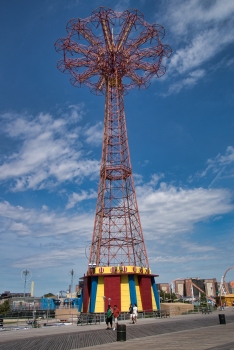
A two-story pavilion is located at the base of the Parachute Jump. The upper floor housed the mechanical structures and hoisting machinery for the ride, while the ground floor contained ticket booths and a waiting room. The pavilion contains six sides, divided by fluted piers that slope upward toward the corrugated galvanized iron roof. The upper floor of the pavilion has red, yellow and blue walls, while the lower floor (below the level of the boardwalk) is a fenced-off open space.:8 The 4-inch-thick (10 cm) concrete platform surrounding the pavilion is located several steps beneath the boardwalk. It was originally intended as a landing pad for riders, and had a radius of 68 feet (21 m) from the center of the tower. An access ramp was located at the northeast corner of the platform.:9

The ride was based on functional parachutes, which dangled from each of the twelve subframes and were held open by metal rings throughout the ascent and descent. Riders were belted into a two-person canvas seat hanging below the closed chute, then hoisted to the top, where a release mechanism would drop them, the descent slowed only by the parachute. Shock absorbers at the bottom, consisting of pole-mounted springs, cushioned the landing. Each parachute required three cable operators, keeping labor expenses high.

Precursors

Originally, parachuting could only be taught by jumping out of airplanes, but by the 1930s, technology had advanced to the extent that towers could also be used to teach parachuting. Stanley Switlik and George P. Putnam, Amelia Earhart's husband, built a 115-foot-tall (35 m) tower on Stanley's farm in Ocean County, New Jersey, now the site of Six Flags Great Adventure. Designed to train airmen in parachute jumping, the tower saw its first public jump on June 2, 1935, when Earhart jumped from the tower.

The Parachute Drop was patented by retired U.S. Naval Commander James H. Strong and Stanley Switlik, who were inspired by primitive parachute practice towers Strong had seen in the Soviet Union.:4 The Soviet Union had been using simple wooden towers to train paratroopers since the 1920s, though Strong designed a safer version which included eight guide wires in a circle surrounding the parachute.:4 Strong filed a patent in 1935 and built several test platforms at his home in Hightstown, New Jersey, in 1936 and 1937. The military platforms suspended a single rider in a harness and offered a few seconds of freefall after the release at the top, before the chutes opened to slow the fall.:4 Civilians showed much interest in trying out the ride, and Strong modified his invention to non-military use, making some design changes in the process. These included a seat that could hold two, a larger parachute for a slower drop, a metal ring that held the parachute permanently open, and shock-absorbing springs to ease the final landing. The modified amusement-ride version was marketed by Miranda Brothers Inc. as a 150-foot-tall (46 m), two-arm parachute jump.:4:4–5

Strong sold military versions of the tower to the Romanian and U.S. militaries. He installed towers at a New Jersey training center, likely Fort Dix. Four were later installed in Fort Benning, Georgia. One was toppled in a 1954 tornado. He also converted an existing observation tower, in Chicago's Riverview Park, into a six-chute amusement ride. This enterprise, the "Pair-O-Chutes", performed adequately enough to inspire Strong to apply to build and operate a jump at the 1939 New York World's Fair.:5

Operation

1939 World's Fair

Construction of the jump at the World's Fair started in December 1938; at the time, it was to be located in the fair's "Amusement Zone". The Life Savers company sponsored the ride, investing $15,000 and decorating the new tower with brightly lit candy-shaped rings.:5 Elwyn E. Seelye & Co. designed the steelwork, while Bethlehem Steel manufactured the pieces and Skinner, Cook & Babcock assembled the pieces onsite. Construction costs amounted to about $99,000.:5

The Parachute Jump opened on May 27, 1939, with five operational parachutes. The structure had in total 12 parachute bays, each 32 feet (9.8 m) in diameter. At the fair, 11 parachutes were used, leaving the tower with one empty arm.:5 The ride was originally 262 feet (80 m) tall, constituting the 250-foot-tall (76 m) tower and a 12-foot (3.7 m) flagpole. The pole was added to surpass the height of a statue on the nearby Soviet pavilion,:4:5 following protests that the Soviet statue would fly higher than the Flag of the United States. Adult riders paid 40 cents, children 25. The trip up took about a minute and the drop down was over in 10 or 20 seconds. The official 1939 Fair guidebook describes the ride:

Eleven gaily-colored parachutes operated from the top of a 250-foot tower, enable visitors to experience all the thrills of "bailing out" without the hazard or discomfort. Each parachute has a double seat suspended from it. When two passengers have taken their places beneath the 'chute, a cable pulls it to the summit of the tower. An automatic release starts the drop, and the passengers float gently to the ground. Vertical guide wires prevent swaying, a metal ring keeps the 'chute open at all times, and shock-absorbers eliminate the impact of the landing. One of the most spectacular features of the Amusement Area, this is also a type of parachute jump similar to that which the armies of the world use in early stages of training for actual parachute jumping.

On July 12, 1939, entangled cables left a couple surnamed Rathborne aloft for five hours in the middle of the night, though they returned to ride again the next day. Another couple, Arno Rudolphi and Ann Hayward, were married on the ride in a celebrated "parachute wedding". The entire wedding party was suspended aloft until the newlyweds completed their vows and descended. At least two other jams occurred on the Parachute Jump in its first year: a deputy sheriff and his sister-in-law later in July 1939, as well as two female friends in September 1939.

The Parachute Jump was negatively affected by its secluded location away from the World's Fair's main entrance. When the Life Savers sponsorship ended in 1939, the ride was relocated closer to the entrance of the World's Fair station, near the fair's Children's World section, at a cost of $88,500. An additional chute and new foundations were added.:6:5–6 The movement of the Parachute Jump, as well as consolidation of concessions at that location, helped improve business for the world's fair's 1940 season. The reopening was delayed due to disagreements between operator International Parachuting Inc. and James Strong; these disagreements included a lawsuit filed by International Parachuting against Strong to prevent him from selling the rights to the ride to other people. Parachute Jump reopened in June 1940. At the end of the fair that October, the Parachute Jump was slated to be sent to either Coney Island, Brooklyn, or Palisades Park, New Jersey. However, there had been discussion of a probable relocation to Coney Island as early as August 1940, and both Luna Park and Steeplechase Park in Coney Island had been interested in purchasing the ride.

Steeplechase Park

The Tilyou family, owners of Steeplechase Park, ended up purchasing the Parachute Jump for $150,000.:7 At the time, the park was still recovering from a conflagration in September 1939, which caused $200,000 in damage and injured 18 people. The fire had destroyed many of the larger attractions, including a Flying Turns roller coaster, whose site still stood empty a year after the blaze. The Parachute Jump was disassembled and moved to the site of the Flying Turns coaster in Steeplechase Park, adjacent to the Riegelmann Boardwalk. The ride required some modifications in its new, windier shore-side location, including the addition of 30-foot-deep (9.1 m) foundations. The jump opened in its new location in 1941. Originally the ride used the multicolored chutes from the World's Fair, but by the mid-1940s these had been replaced with white chutes.:7

A ride on the Parachute Jump was included within the Steeplechase Park ticket, which was 25 cents at the time of the ride's relocation. The jump, which attracted as many as half a million riders annually, was described as "flying in a free fall". Most riders reached the top of the tower in just under a minute and parachuted downward within 11-15 seconds. The Parachute Jump was popular among off-duty service members who took their friends and loved ones to the ride.:7:7–8 Occasionally, riders became stuck mid-jump or were tangled within the cables. The ride was fickle and subject to shutdowns on windy days, and required a crew of 15 people to operate, making it unprofitable. During World War II, when much of the city adhered to a blackout, the ride stayed lit to serve as a navigational beacon.:7

By the 1960s, Coney Island was seeing fewer visitors year-over-year. Crime increases, insufficient parking facilities, bad weather, and the post-World War II automotive boom were cited as contributing factors in the decrease of visitors to Coney Island. This was exacerbated by the start of the 1964 New York World's Fair, also in Flushing Meadows–Corona Park, which resulted in a record low patronage at Steeplechase Park. On September 20, 1964, Steeplechase Park closed for the last time,:172 and the next year, the property was sold to developer Fred Trump, the father of developer and U.S. president Donald Trump. On the site of Steeplechase Park, Fred Trump proposed building a 160-foot-high (49 m) enclosed dome with recreational facilities and a convention center.

Sources disagree on whether the jump closed permanently in the 1964 season or continued to operate until 1968. Charles Denson, a local historian, states that the ride closed in 1964, but that many publications give an erroneous date of 1968. The Coney Island History Project maintains a closing date of 1964, and that the 1968 closing date was based on an inaccurate newspaper article. The Guide to New York City Landmarks also mentions that the ride closed in 1964, while the Brooklyn Paper says that the Jump closed in 1965. Observations seem to bolster a 1964 closure; in a New York Daily News article in 1965, it was observed that the Parachute Jump was not only nonoperational, but also had "been stripped of its wires and chutes". However, The New York Times said in a 1987 article that the jump operated until 1968 but later corrected that to 1964. Kaufmann's History and the NYC Parks website also cite a closure date of 1968, stating that it was one of several small rides that were operated by concessionaires on the site, and a Daily News article from 1973 also said that the ride closed in 1968.

Post-closure

Redevelopment and landmark status

In 1966, the Coney Island Chamber of Commerce petitioned the New York City Landmarks Preservation Commission (LPC) to make the Parachute Jump an official city landmark. On the other hand, Trump wanted to demolish the structure and sell it for scrap because he did not think the landmark was old enough to warrant landmark status. That October, the city announced its plans to acquire the 125 acres (51 ha) of the former Steeplechase Park so that the land could be reserved for recreational use. The city voted to acquired the Steeplechase site in 1969, and control of the jump passed to the city's parks department, NYC Parks. Subsequently, NYC Parks attempted to sell the jump in 1971, but with no success. When NYC Parks was selling the Parachute Jump in 1971, the agency had planned to demolish the Parachute Jump if no one was willing to buy it. However, a study conducted in 1972 found that the jump was structurally sound, and there were proposals to both give landmark status to the tower and install a light show on it.

The city attempted to redevelop the Steeplechase site itself as a state park, though this failed to occur. By the late 1970s, the city government wanted to redevelop the site into an amusement park instead. Norman Kaufman, who had run a small collection of fairground amusements on the Steeplechase site since the 1960s, was interested in reopening the Parachute Jump. He was evicted from the site in 1981, ending discussion of that plan in the interim.

Meanwhile, the abandoned Parachute Jump was frequented by teenagers and young adults who would climb the frame illegally, while the base was covered with graffiti. Despite the deterioration of the jump, it remained a focal point of the community, and it was said that the Parachute Jump could be seen from the ocean 30 miles (48 km) away. Organizations such as the Coney Island Chamber of Commerce and the Gravesend Historical Society made efforts to save the structure, though the LPC could not consider such a designation unless NYC Parks indicated that it was not interested in developing the Parachute Jump site as a park. In July 1977, the LPC designated the tower a city landmark. Three months later the New York City Board of Estimate overturned the landmark designation, citing doubts about the tower's structural integrity. Despite the city's reluctance to landmark the structure, the Parachute Jump was placed on the National Register of Historic Places in 1980.

The city still had major concerns about the structure's safety. A structural survey of the tower was commissioned in 1982, and it concluded that the tower would need a $500,000 renovation just to stabilize it, plus another $1 million to restore it as a ride. The same analysis estimated that it would cost at least $300,000 to demolish the structure, and that the actual price might be even higher, making demolition too costly of an option. NYC Parks commissioner Henry Stern dismissed the possibility of making the Parachute Jump operational again, calling it a "totally useless structure" and saying that even the actual Eiffel Tower had a restaurant. Stern said that he welcomed the community's proposals for reusing the Parachute Jump, but other agency officials said that the plans presented thus far, which included turning the jump into a giant windmill, were "quixotic, at best". In the mid-1980s, restaurant mogul Horace Bullard proposed rebuilding Steeplechase Park,:150 which included making the Parachute Jump operational again. At the time, the Parachute Jump was described as a "symbol of despair", given that no real effort had been made to restore or even clean up the structure.

City landmark status was discussed again in 1987, when the LPC hosted meetings to determine the feasibility of granting landmark status to the Parachute Jump, Wonder Wheel, and Coney Island Cyclone. Two years later, the LPC restored city landmark status to the Parachute Jump. Following this, the Board of Estimate granted permission for Bullard to develop his amusement park on the Steeplechase site, including reopening the Parachute Jump. However, these plans were delayed due to a lack of funds.

Restorations and lighting

In 1991, despite a citywide fiscal crisis, the city announced that it would spend $800,000 to prevent the Parachute Jump from collapsing. The city painted and stabilized the structure in 1993, painting it in its original colors, although the structure still suffered from rust in the salt air. The thrill-ride company Intamin was enlisted to determine if the Parachute Jump could again be made operational, but that did not come to pass. Bullard's redevelopment plan had clashed with another proposal that would build an amateur sports arena, such as a minor-league baseball stadium, on the site. The Bullard deal was negated in 1994,:150 and the site directly to the north of the Parachute Jump was developed as KeySpan Park (now MCU Park), which opened in 2000.

The New York City Economic Development Corporation (NYCEDC) assumed responsibility for the Jump in 2000. Originally, it was planned that the city would reopen the Parachute Jump as an actual ride, but it was dismissed due to the high cost of the redesigns that were necessitated to bring the ride to modern safety standards. The planned renovation would have cost $20 million, excluding the large amount of insurance that would need to be paid in order to operate the ride.

2002 restoration and first lighting project

A $5 million, 18-month restoration plan by the NYCEDC started in 2002. The NYCEDC contracted engineering firm STV to rehabilitate the structure. The upper part of the structure was dismantled, about two-thirds of the original structure was taken down and replaced, and the structure was painted red. The restoration was completed around July 2003. Upon the completion of the rehabilitation, Brooklyn Borough president Marty Markowitz started studying proposals to reuse or reopen the structure. In 2004, STV subcontracted Leni Schwendinger Light Projects to develop a lighting concept for the Parachute Jump. Schwendinger contracted Phoster Industries for the LED portion of the lighting project. Markowitz's office, NYC Parks, the NYCEDC, Schwendinger, and STV collaborated for two years on the project. The project cost $1.45 million.

Also in 2004, the Coney Island Development Corporation and the Van Alen Institute held an architecture contest to determine future uses for the 7,800-square-foot (720 m²) pavilion at the jump's base. More than 800 competitors from forty-six countries participated, of which only 150 were from New York. In 2005, was announced one winning team, two runner-ups with cash prizes, and nine honorable mentions. The winning design outlined a bowtie-shaped pavilion with lighting and an all-season activity center, which included a souvenir shop, restaurant, bar, and exhibition space.

On July 7, 2006, the lighting installation designed by Schwendinger made its public debut. The installation contained six possible animations and used most colors save for green, which would not be visible on the tower's red frame. The scenarios were programmed around events in the local calendar, including the boardwalk's operating and non-operating seasons; the lunar cycle; the Coney Island Mermaid Parade; and patriotic-themed national holidays such as Memorial Day or Labor Day. There is also a sequence called "Kaleidoscope" for other holidays. Officials stated that the lights were to be left on from dusk to midnight during summer, and from dusk to 11 p.m. the rest of the year. In observance of the "Lights Out New York" initiative, the tower lighting went dark at 11 p.m. during the bird migratory seasons.

2013 restoration and second lighting project

At first, Markowitz was said to have been satisfied with Schwendinger's light installation, but by 2007, he was referring to her installation as "Phase I" of the Parachute Jump's lighting upgrades, implying his dissatisfaction with the lights that had been installed to date. In February 2008, the city started planning the installation of a second phase of lights. Anti-climbing devices were installed on the Parachute Jump in 2010 after several instances where people were able to climb the structure, and the lights were temporarily turned off in 2011 due to a lack of maintenance.

A $2 million renovation of the Parachute Jump was completed in 2013. After the upgrade, the Parachute Jump contained 8,000 LED lights, an increase from the 450 that were there before. The historic B&B Carousell, part of Luna Park, was relocated to a site directly to the east of the Parachute Jump in 2013. The Jump held its first New Year's Eve Ball drop at the end of 2014, and since then, the Parachute Jump has been lit for New Year's Eve each year. The Parachute Jump also started lighting up in recognition of special causes, such as World Autism Awareness Day and Ovarian Cancer Awareness Month.

Text imported from Wikipedia article "Parachute Jump" and modified on July 23, 2019 according to the CC-BY-SA 4.0 International license.

Participants

Currently there is no information available about persons or companies having participated in this project.

Relevant Web Sites

  • About this
    data sheet
  • Structure-ID
    20026239
  • Published on:
    19/02/2007
  • Last updated on:
    03/11/2025
Structurae cooperates with
International Association for Bridge and Structural Engineering (IABSE)
e-mosty Magazine
e-BrIM Magazine