
Submerged Floating Tunnels - Sensitivity in High Currents
|
|
|||||||||||
Détails bibliographiques
| Auteur(s): |
J. Connell
|
||||
|---|---|---|---|---|---|
| Médium: | papier de conférence | ||||
| Langue(s): | anglais | ||||
| Conférence: | IABSE Symposium: Synergy of Culture and Civil Engineering – History and Challenges, Wrocław, Poland, 7-9 October 2020 | ||||
| Publié dans: | IABSE Symposium Wroclaw 2020 | ||||
|
|||||
| Page(s): | 406-413 | ||||
| Nombre total de pages (du PDF): | 8 | ||||
| Année: | 2020 | ||||
| DOI: | 10.2749/wroclaw.2020.0406 | ||||
| Abstrait: |
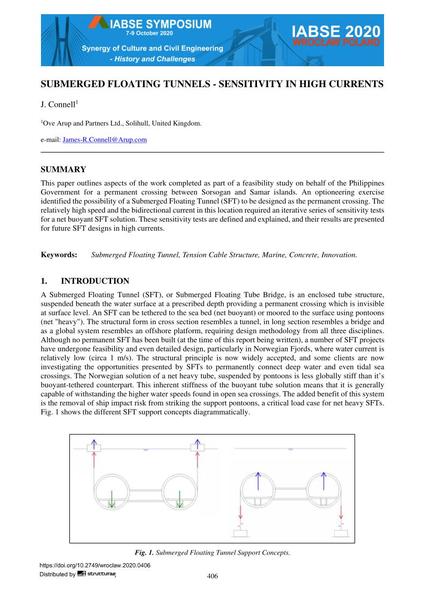
This paper outlines aspects of the work completed as part of a feasibility study on behalf of the Philippines Government for a permanent crossing between Sorsogan and Samar islands. An optioneering exercise identified the possibility of a Submerged Floating Tunnel (SFT) to be designed as the permanent crossing. The relatively high speed and the bidirectional current in this location required an iterative series of sensitivity tests for a net buoyant SFT solution. These sensitivity tests are defined and explained, and their results are presented for future SFT designs in high currents. |
||||
| Mots-clé: |
béton innovation
|
||||
